





Improving the Check-In Experience: Front Desk Best Practices for Guest Satisfaction
Posted by Amenie on Jul 20, 2026
The front desk sets the terms of the entire stay. Within the first five minutes of arrival, a guest has already formed a judgment about whether the property meets the standard they expected when they booked. That judgment—shaped by wait time, staff demeanor, process efficiency, and the physical state of the lobby—carries into every subsequent interaction, from the room reveal to the review they write after checkout.
For operations leaders managing occupancy pressure, lean staffing, and review-driven demand, the check-in process is where brand promise meets operational reality. A disorganized arrival experience creates compounding problems: guests arrive at the room already skeptical, minor issues that might have gone unnoticed become confirmation of a pattern, and the front desk team spends the rest of the stay in recovery mode rather than delivering hospitality.
The operational challenge is real. Peak arrival windows compress staffing capacity. Technology adoption varies widely across property types. And the definition of a “good” check-in experience has shifted—guests now compare hotel arrivals against the frictionless digital transactions they experience everywhere else. What follows is a practical framework for improving the check-in experience through systems, training, and operational consistency—built for the realities of running a property, not the ideals of a conference presentation.
Why the Check-In Experience Has Outsized Impact on Guest Satisfaction
What Makes Hotel Check-In So Important for Guest Reviews?
Check-in is the first live interaction between a guest and the property. Unlike photos on a booking site or a confirmation email, it is unfiltered and immediate. The guest is physically present, often after hours of travel, and their tolerance for friction is at its lowest point of the entire stay.
This creates a psychological dynamic that experienced operators understand well: first impressions anchor the entire guest experience. A smooth, efficient check-in sets a positive baseline. The guest enters the room expecting quality and tends to interpret minor imperfections charitably. A frustrating check-in—long wait, disengaged staff, missing reservation details, a lobby that feels neglected—does the opposite. It primes the guest to notice problems, and it makes recovery significantly harder for the rest of the team.
The review data support this. Negative online reviews frequently reference the arrival experience as the moment the stay “started going wrong.” Conversely, properties that consistently earn high satisfaction scores tend to share a common trait: a check-in process that feels organized, personal, and efficient, even during peak demand. That trait almost always traces back to the front desk team and how they've been trained to handle each interaction — How to Train Hotel Staff for Better Guest Communication and Service walks through what that actually looks like in practice.
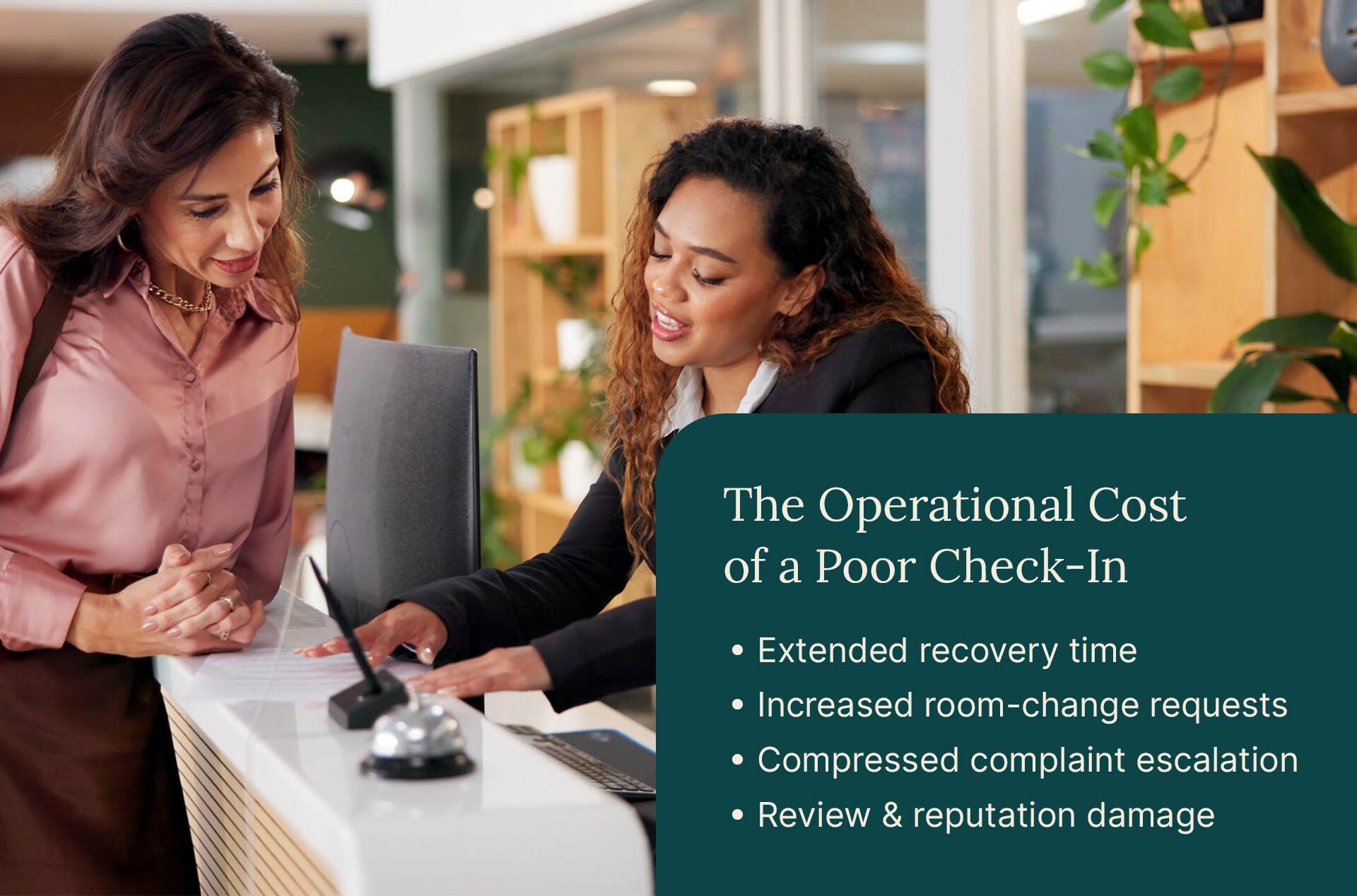
The Operational Cost of a Poor Check-In
- Extended recovery time: When a guest arrives frustrated, every department downstream—housekeeping, F&B, concierge—inherits the burden of resetting expectations. This consumes staff time and management attention that could be directed elsewhere.
- Increased room-change requests: Guests who check in with a negative impression are more likely to request room changes for issues they might otherwise overlook, creating operational disruption during peak turnover.
- Compressed complaint escalation: A poor check-in experience shortens the guest’s patience for any subsequent issue. Problems that would normally generate a polite mention at checkout instead escalate to management intervention or real-time negative social media.
- Review damage: The check-in experience is one of the most frequently cited elements in both positive and negative reviews, giving it disproportionate influence on a property’s online reputation.
What Are the Most Common Hotel Check-In Problems?
Understanding where check-in experiences break down is the first step toward building systems that prevent those failures. Most check-in complaints fall into a handful of recurring categories.
Process and Efficiency Failures
- Excessive wait times: Understaffing during peak arrival windows is the single most common check-in complaint. When guests stand in line for ten or fifteen minutes after a long trip, the stay begins on a deficit, regardless of how friendly the eventual interaction is.
- Slow or unreliable technology: Property management systems that freeze, key-card encoders that malfunction, or credit card terminals that time out create visible friction that undermines guest confidence in the property.
- Missing or incorrect reservation details: When special requests, loyalty preferences, or rate confirmations don’t surface at check-in, the guest feels unseen—and the front desk agent is forced into a reactive troubleshooting role rather than a welcoming one.
Staff and Communication Failures
- Scripted, impersonal interactions: Guests can tell when a front desk agent is reciting a script versus engaging with them as an individual. Overly rigid scripting removes the warmth that defines genuine hospitality.
- Failure to acknowledge wait or inconvenience: When a guest has been waiting, and the agent doesn’t acknowledge it, the message received is one of indifference. A brief, sincere acknowledgment immediately resets the dynamic.
- Inconsistent information delivery: When one agent quotes a different policy or amenity availability than another, it erodes trust. Guests don’t distinguish between individual agents—they judge the property.
Physical Environment Failures
- Lobby condition at arrival: A lobby that looks tired, smells stale, or has visible maintenance issues during peak check-in hours communicates that the property is not prepared for guests. Keeping common areas guest-ready requires the same preventive approach used in guest rooms.
- Lack of wayfinding or signage: Guests arriving at a property for the first time need clear directional cues—parking, entrance, front desk location, elevator access. Confusion during arrival adds friction to an already transitional moment.
- Room not ready at stated check-in time: This is one of the most damaging check-in failures, particularly for guests who have timed their arrival to the posted check-in window. It signals operational disorganization and leaves the front desk with limited recovery options.
Front Desk Best Practices for a Better Check-In Experience
The following practices address the most impactful areas of the check-in experience. Each is designed to be implemented within existing operational structures without requiring major capital investment.
1. Staff the Desk to Match Arrival Patterns, Not Just Shift Schedules
Most properties staff the front desk based on fixed shift schedules. The problem is that guest arrivals don’t follow fixed patterns. A property with a 3:00 PM check-in time will see arrivals cluster between 3:00 and 6:00 PM, with a secondary wave from late-afternoon flights and business travelers arriving in the evening. Staffing should reflect these patterns.
Why it matters: Wait time is the number-one driver of check-in dissatisfaction. Adding even one additional agent during the peak arrival window can cut average wait times significantly and prevent the cascading frustration that comes from a backed-up lobby.
Implementation:
- Analyze PMS arrival data to identify your property’s actual peak check-in windows by day of week and season
- Build a flexible staffing model that adds front desk coverage during predictable peak windows
- Cross-train concierge, guest services, or operations staff to provide front desk support during surge periods
- Monitor real-time lobby traffic and empower a shift lead to call in backup before lines form, not after
- Track average check-in time per agent weekly to identify training needs and process bottlenecks

2. Pre-Arrival Communication and Preparation
The best check-in experiences begin before the guest arrives. Pre-arrival communication allows properties to confirm details, set expectations, collect preferences, and resolve potential issues while there is still time to act—rather than handling everything in the lobby under time pressure.
Why it matters: Every question answered before arrival is one less question creating friction at the desk. Pre-arrival contact also signals to the guest that the property is organized and attentive, establishing a positive impression before they walk through the door.
Implementation:
- Send a pre-arrival message 24–48 hours before check-in confirming reservation details, check-in time, and parking or arrival instructions
- Include a brief preference prompt: early check-in interest, pillow type, celebration occasions, or accessibility needs
- Flag special requests in the PMS so they surface automatically when the agent pulls up the reservation
- For returning guests, review past stay notes and proactively address known preferences or past issues
- Confirm room readiness status internally before the guest’s expected arrival time
3. Streamline the Physical Check-In Process
The mechanical steps of check-in—ID verification, payment authorization, key encoding, folio signature—should be as fast and seamless as possible. Every unnecessary step, repeated question, or system delay adds friction that the guest feels, even if the agent is warm and professional.
Why it matters: Guests compare hospitality check-in against every other transaction in their lives. They tap a phone to board a flight, scan a code to enter an event, and unlock a rental car from an app. A check-in process that requires five minutes of paperwork and system navigation feels outdated—even if it’s technically efficient by hospitality standards.
Implementation:
- Audit your current check-in process step by step and identify any redundant data collection, unnecessary signatures, or manual workarounds
- Evaluate mobile check-in, digital key, or kiosk options appropriate to your property type and guest profile
- Pre-authorize payment and verify ID digitally where possible so the desk interaction focuses on welcome, not administration
- Ensure key-card systems, PMS terminals, and payment devices are maintained and tested daily—technology failures during check-in are visible and damaging
- Position registration materials, key packets, and welcome collateral within arm’s reach of every front desk station to eliminate unnecessary movement
4. Train for Conversation, Not Scripts
Scripted check-in language has its place—it provides consistency and ensures required information is communicated. But the best front desk interactions feel like conversations, not recitations. Training should give agents a framework and required touchpoints, then trust them to deliver those touchpoints in their own voice.
Why it matters: Guests can detect scripted interactions immediately, and the effect is distancing. A front desk agent who makes genuine eye contact, acknowledges the guest by name, and responds naturally to conversational cues creates a personal connection that a script cannot replicate.
Training framework:
- Define required check-in touchpoints (welcome, name confirmation, stay details, key information, amenity highlights, invitation to contact the desk) but allow agents to deliver them conversationally
- Role-play common arrival scenarios: the tired business traveler, the family with children, the celebrating couple, the guest arriving to a room that isn’t ready
- Train agents to read cues—some guests want a warm, detailed welcome; others want efficiency above all else. The best agents adjust their approach in real time
- Coach agents on recovery language: how to acknowledge a wait, apologize for an issue, and offer a solution without over-promising
- Include front desk communication in regular performance reviews, not just annual training —for a broader training framework that applies across departments, see our Housekeeping Training Program.
5. Make the Lobby Arrival-Ready During Peak Windows
The lobby is the stage for check-in. Its condition at the moment a guest walks through the door shapes their first impression of the entire property. During peak check-in hours, the lobby should be at its best—not still recovering from afternoon housekeeping or mid-day event turnover.
Why it matters: A guest’s assessment of the property begins the moment they see the entrance. A lobby that looks clean, smells fresh, and feels well-maintained signals that the rest of the property will meet the same standard. A lobby that looks neglected signals the opposite—and that impression is very difficult to reverse.
Implementation:
- Schedule a dedicated lobby refresh 30–60 minutes before peak check-in begins: floors, surfaces, restrooms, seating areas, and entrance glass
- Verify that lobby lighting, temperature, and background music are set to arrival standards—these sensory details shape perception before the guest reaches the desk
- Address odor proactively with appropriate scenting and ventilation, particularly in lobbies with adjacent food service or high foot traffic
- Keep public restrooms near the lobby inspection-ready during check-in hours—guests frequently use these immediately upon arrival
- Remove any operational clutter— housekeeping carts, maintenance equipment, delivery boxes—from guest-visible areas before the arrival window

6. Deliver a Consistent Room-Ready Standard
The check-in experience does not end at the front desk. It ends when the guest opens the door to their room and confirms that the property delivers on the expectation that was set at the desk. A smooth, warm check-in followed by a room that has a burned-out light, a missing amenity, or an unmade bed is a compounding failure.
Why it matters: The room reveal is the payoff of the check-in experience. Everything the front desk agent communicated—the quality of the property, the care for the guest, the attention to detail—is either confirmed or contradicted the moment the guest walks into the room.
Implementation:
- Establish a room-ready checklist that housekeeping completes before marking any room available for check-in
- Verify amenity stocking as a required step in room preparation— bath and body products, towels, paper goods, and personal care items should all be confirmed
- Conduct spot-check inspections on a rotating sample of rooms each day, particularly rooms assigned to loyalty members, celebrating guests, or long-stay reservations
- Build a communication bridge between the front desk and housekeeping so that special requests flagged at check-in (extra pillows, specific floor preference, accessibility needs) are confirmed fulfilled before the guest receives their key
- Address the sensory details: room temperature set to standard, curtains positioned consistently, lighting on, and no lingering cleaning product or musty odor
7. Personalize Without Over-Engineering
Personalization at check-in does not require elaborate technology or complex CRM integrations. It requires attention. Noting a returning guest’s name, remembering a preference from a past stay, or acknowledging a special occasion mentioned during booking are small actions that create disproportionate impact.
Why it matters: Guests at boutique and independent properties in particular are choosing smaller operations specifically because they expect a more personal experience than what a large chain delivers. Personalization at check-in validates that choice and sets the tone for the rest of the stay.
Implementation:
- Use PMS notes and pre-arrival data to brief front desk agents on arriving guests—especially returning guests, loyalty members, and those with flagged occasions
- Train agents to use the guest’s name naturally during the interaction (once or twice, not excessively)
- For returning guests, a simple “Welcome back” with a reference to their last visit creates a meaningful connection with minimal effort
- Coordinate with housekeeping on occasion-specific room touches (a handwritten note, a small amenity upgrade) that the front desk can mention during check-in— single-use amenities work well for these personalized touches
- Avoid over-personalization—referencing too many details about a guest’s history can feel intrusive rather than attentive. Read the guest’s cues and calibrate accordingly
8. Close the Check-In with Clear, Useful Information
How the check-in interaction ends matters almost as much as how it begins. The final thirty seconds should leave the guest feeling informed and confident about navigating their stay—not overwhelmed with information or uncertain about next steps.
Why it matters: A guest who reaches their room and immediately has a question—about Wi-Fi, breakfast hours, pool access, or how to adjust the thermostat—has to contact the desk again. That second interaction is not a positive touchpoint; it is a process failure that could have been prevented during check-in.
Implementation:
- Identify the five to seven most common post-check-in questions your front desk receives and proactively address them during the check-in interaction
- Provide a brief, clear orientation: Wi-Fi access, dining hours, fitness or spa access, and the best way to contact the desk
- Use a physical or digital welcome guide in the key packet for details the guest can reference later, rather than trying to communicate everything at the desk verbally
- End with an open invitation: “If there’s anything at all during your stay, the front desk is here for you.” This should feel genuine, not scripted
- For properties with spa, pool, or fitness facilities, a brief mention of hours and location can drive utilization and enhance the perceived value of the stay
Front Desk Check-In Audit Checklist
Use this checklist to evaluate and improve your current check-in process. Each item addresses a specific element that contributes to guest satisfaction during arrival.
|
Pre-Arrival |
|
|---|---|
|
☐ |
Pre-arrival message sent 24–48 hours before check-in |
|
☐ |
Special requests flagged and visible in PMS |
|
☐ |
Returning guest preferences reviewed and noted |
|
☐ |
Room readiness confirmed before guest’s expected arrival |
|
☐ |
Early check-in requests communicated to housekeeping |
|
Lobby & Environment |
|
|
☐ |
Lobby refresh completed 30–60 minutes before peak check-in |
|
☐ |
Lighting, temperature, and music set to arrival standards |
|
☐ |
Public restrooms inspected and stocked |
|
☐ |
Operational clutter removed from guest-visible areas |
|
☐ |
Wayfinding signage clear and visible |
|
Desk Process & Staffing |
|
|
☐ |
Front desk staffed to match actual peak arrival patterns |
|
☐ |
Cross-trained backup staff available during surge windows |
|
☐ |
PMS, key encoders, and payment terminals tested daily |
|
☐ |
Registration materials and key packets pre-staged at each station |
|
☐ |
Average check-in time tracked and reviewed weekly |
|
Guest Interaction & Close |
|
|
☐ |
Agent uses guest name naturally during interaction |
|
☐ |
Wait or inconvenience acknowledged (if applicable) |
|
☐ |
Key information communicated: Wi-Fi, dining, amenities, contact |
|
☐ |
Personalization touchpoints delivered where appropriate |
|
☐ |
Open invitation to contact the desk extended at close |
How a Strong Check-In Process Drives Better Guest Reviews
The connection between check-in quality and online review scores is direct and consistent across the hospitality industry. When guests write positive reviews, they frequently reference specific arrival details: a warm greeting by name, a fast and organized process, a room that was ready and well-prepared. When they write negative reviews, the arrival experience is often cited as the moment the stay’s trajectory shifted.
What makes check-in uniquely influential in the review equation is recency and primacy. The check-in experience is the first substantive interaction—it anchors the narrative the guest constructs about their stay. And because it is a discrete, contained event (unlike the cumulative experience of the room or the dining experience), guests can recall and describe it clearly. This makes it one of the most frequently cited elements in both positive and negative review text.
Properties that invest in check-in consistency see two measurable outcomes: fewer low-scoring reviews driven by arrival frustration, and more high-scoring reviews that specifically praise the welcome experience. Over time, this shifts the property’s overall review profile and strengthens its competitive position on booking platforms where review scores directly influence visibility and conversion.
Beyond reviews, a strong check-in process reduces operational burden across the property. Guests who arrive satisfied make fewer complaint calls, request fewer room changes, and require less management intervention during their stay. Maintaining consistent quality across linens, guest room supplies, and housekeeping essentials supports this standard from the front desk through checkout.
Turning Check-In Into a Competitive Advantage
The check-in experience is not a formality. It is the operational moment where a property’s brand promise is either validated or undermined—and the guest’s expectations for the entire stay are set.
The best-performing properties treat check-in as a system, not an event. They staff to match arrival demand, prepare the lobby and rooms before guests arrive, train agents to deliver genuine hospitality within an efficient framework, and use pre-arrival communication to eliminate unnecessary friction at the desk. None of these practices require transformative technology or significant capital investment. They require operational discipline, consistent training, and a willingness to measure performance and adjust.
In hospitality, first impressions compound. A strong check-in experience makes every subsequent interaction easier—for the guest, for the front desk team, and for every department that follows. It reduces complaints, improves reviews, and creates the conditions for the kind of guest satisfaction that drives repeat business and referrals.
For operations leaders, the question is not whether check-in matters. The question is whether your current process reflects the standard your property is trying to deliver.
Frequently Asked Questions About Hotel Check-In Best Practices
What is the ideal check-in time for hotels?
Most hotels set check-in between 3:00 and 4:00 PM, which allows adequate time for room turnover after standard 11:00 AM or 12:00 PM checkout. The specific time should be based on your property’s housekeeping capacity and turnover workflow. Offering early check-in as a request (not a guarantee) and communicating room readiness via text or app notification can significantly reduce lobby congestion and improve guest satisfaction.
How can hotels reduce check-in wait times?
The most effective approach is staffing to match actual arrival patterns rather than fixed shift schedules. Analyze your PMS data to identify peak arrival windows by day and season, then add front desk coverage during those periods. Cross-training other departments to provide desk support during surges, pre-authorizing payment before arrival, and offering mobile or kiosk check-in options also reduce wait times without requiring additional permanent headcount.
Should hotels offer mobile or contactless check-in?
Mobile and contactless check-in options work well for certain guest segments, particularly frequent business travelers and tech-comfortable leisure guests who prioritize speed over personal interaction. However, these tools supplement the front desk—they do not replace it. Many guests, especially at boutique and full-service properties, value the personal welcome that a staffed desk provides. The best approach is to offer digital options as a choice while maintaining a high-quality in-person experience for guests who prefer it.
How do you train front desk staff for better guest interactions?
Effective front desk training focuses on frameworks rather than rigid scripts. Define the required touchpoints for every check-in interaction—greeting, name use, stay details, key information, close—then allow agents to deliver them in their own voice. Regular role-playing of common scenarios (late arrivals, room-not-ready situations, guest complaints) builds confidence. Include check-in communication quality in ongoing performance reviews rather than limiting training to onboarding.
What should the front desk communicate during check-in?
Focus on the information that prevents post-check-in calls and frustration. At minimum, cover Wi-Fi access, dining hours and location, fitness or spa access, the best way to reach the front desk, and any property-specific information (parking, elevator location, ice machine). Provide a physical or digital welcome guide for reference, and close with an open invitation to contact the desk with any needs.
How does the lobby environment affect the check-in experience?
The lobby is the physical context for check-in—its condition directly shapes the guest’s first impression before they interact with a single staff member. A clean, well-lit, fresh-smelling lobby signals quality and care. A neglected lobby signals the opposite. Schedule a dedicated lobby refresh before peak check-in hours, covering floors, surfaces, restrooms, lighting, temperature, and scent. Remove any operational clutter from guest-visible areas.
Related Resources from Amenie
Continue exploring strategies for consistent guest satisfaction: