




How to Set Hotel Amenity Par Levels by Room Count
Posted by Amenie on Aug 05, 2026
Quick Answer: Hotel amenity par levels are the minimum quantity of each guest supply a property keeps on hand between deliveries so it never runs short. To set them by room count, use this formula:
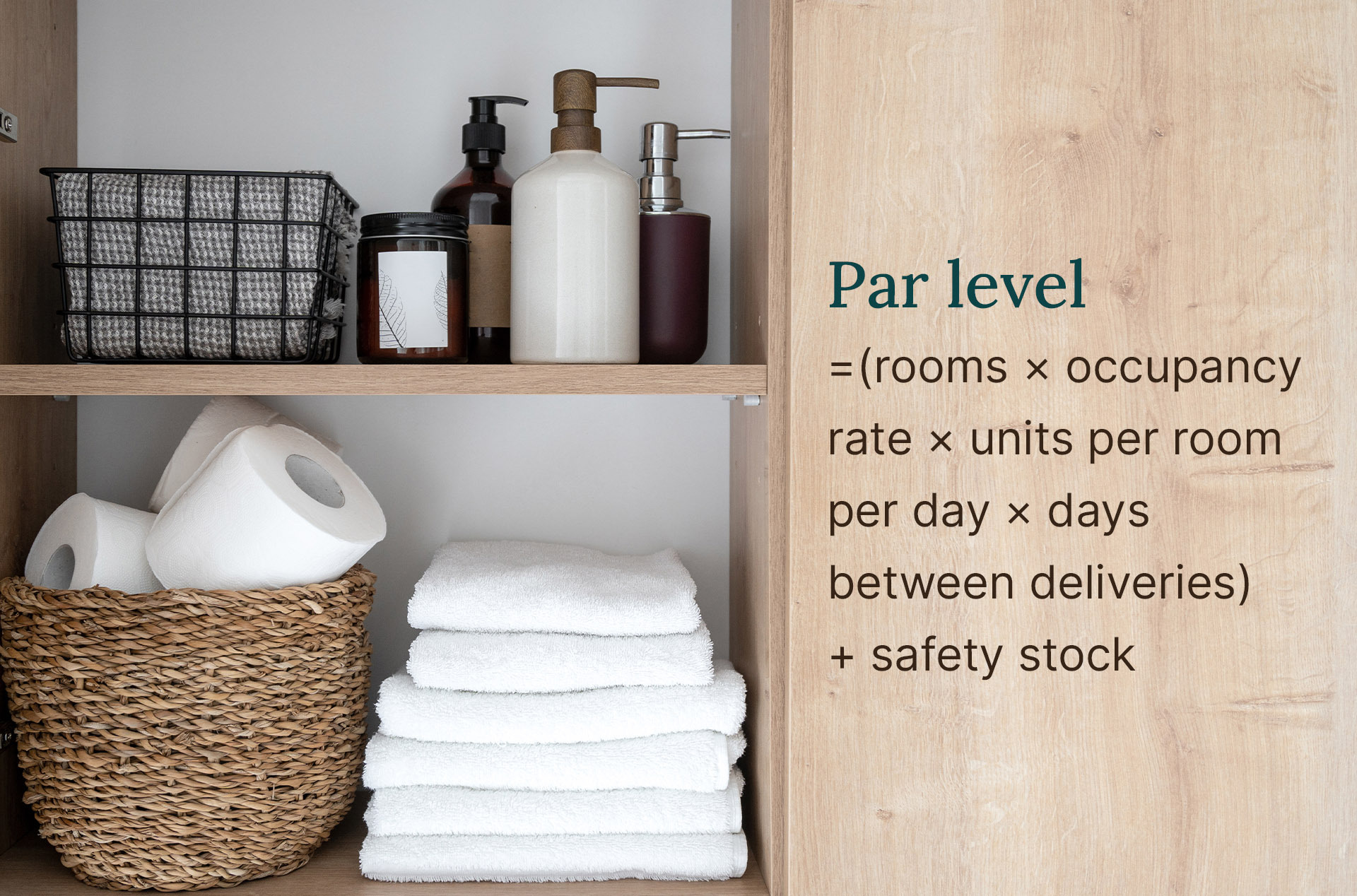
Par level = (rooms × occupancy rate × units per room per day × days between deliveries) + safety stock
For a 100-room property at 75% occupancy, ordering shampoo (1 unit per occupied room per day) on a 14-day cycle with 20% safety stock, the par level is 1,260 units. Adjust the usage rate by amenity type (shampoo about 1.0, lotion about 0.4 to 0.5, dental kits about 0.2 per check-in) and recalculate whenever occupancy or supplier lead time changes.
Running out of shampoo on a sold-out Saturday night is a housekeeping nightmare. Your guests are unhappy, your front desk hears about it, and your reviews reflect it. But the opposite problem is just as real: overordering ties up cash, strains storage space, and leaves you sitting on three years' worth of dental kits that nobody requested.
The fix is a par level system. Not a vague “order enough to get through the week” approach, but an actual formula tied to your room count, occupancy, and delivery schedule.
By the end of this guide, you'll know exactly how many amenities to keep on hand, when to trigger a reorder, and which mistakes to stop making.
Here's what we'll cover:
- What hotel amenity par levels are and why they matter
- The core par level formula with a worked example
- A ready-to-use table by room count
- How par levels shift by amenity type
- How to set reorder points (not just par levels)
- The most common ordering mistakes and how to avoid them
What Are Hotel Amenity Par Levels?
A par level is the minimum quantity of an item your property needs to have on hand at any given time to meet guest demand between deliveries without running short.
Think of it as your inventory floor, not your target order quantity. When stock drops to the par level, it's time to reorder. When you receive a delivery, you bring inventory back above that threshold.
What amenity par levels typically cover
Par levels apply to any in-room or upon-request guest supply, including:
- Shower amenities: shampoo, conditioner, body wash, bar soap, lotion
- Vanity items: dental kits, shaving kits, vanity kits, cotton rounds
- Room comfort items: slippers, shower caps, sewing kits, robes
- Request-based items: extra toiletries, specialty products for extended stays
Key distinction: Par levels are not the same as your order quantity. Your order quantity is how much you buy to get back above par. Your par level is the trigger point that tells you when to order.
Setting par levels by room count gives your housekeeping team a clear, consistent rule to follow, rather than relying on gut feel or whoever happens to notice the supply closet is low.
Why Room Count Alone Is Not Enough
Room count is where the calculation starts, not where it ends. A 100-room property running at 40% occupancy in January needs a very different par level than the same property at 95% occupancy over a holiday weekend.
The variables that actually drive amenity consumption:
| Variable | Why it matters |
|---|---|
| Occupancy rate | Unused rooms consume zero amenities |
| Average length of stay | Multi-night guests may use more than one unit per amenity type |
| Amenity type | Shampoo usage differs significantly from lotion or dental kit usage |
| Replenishment policy | Daily refresh vs. upon request changes your daily draw |
| Guest profile | Business travelers vs. leisure guests vs. families use amenities differently |
| Seasonality | Peak season often runs well above your annual average occupancy |
| Supplier lead time | Longer lead times require higher safety stock |
| Storage capacity | Physical space limits how much you can hold regardless of the math |
A property that orders based on room count alone is almost always either understocked during peak periods or overstocked on slow-moving items. For purchasing teams managing multiple properties, the same variables apply at the portfolio level: standardized per-property formulas and consolidated reorder cycles are what keep multi-location procurement from becoming a guessing game. The formula below accounts for all of these factors.
The Basic Amenity Par Level Formula
Here is the core formula used by most housekeeping and procurement teams:
Par level = (rooms × occupancy rate × units per room per day × days between deliveries) + safety stock
Each variable is straightforward once you have your property's numbers in hand.
Defining the variables
- Rooms: Your total room count
- Occupancy rate: Your average occupancy as a decimal (75% = 0.75). Use your trailing 90-day average, not your peak.
- Units per room per day: How many of a given amenity each occupied room uses in one day. Shampoo is typically 1 unit. Lotion is closer to 0.5.
- Days between deliveries: Your reorder cycle. If you order every two weeks, this is 14.
- Safety stock: A buffer to cover occupancy spikes, delayed deliveries, or usage that runs higher than expected.
Worked example: shampoo for a 100-room property
- 100 rooms
- 75% average occupancy
- 1 shampoo unit per occupied room per day
- 14-day reorder cycle
- 20% safety stock
Base units: 100 × 0.75 × 1 × 14 = 1,050 units
Safety stock (20%): 1,050 × 0.20 = 210 units
Recommended par level: 1,260 shampoo units
When your shampoo inventory drops to 1,260 units, place your next order. That buffer covers two weeks of normal usage plus a 20% cushion for unexpected demand.
Par Level Examples by Room Count
The table below applies the formula across five common property sizes. All examples assume shampoo as the amenity (1 unit per occupied room per day), a 14-day reorder cycle, and 75% average occupancy. Safety stock is set at 20%.
| Property Size | Avg. Occupancy | Rooms Occupied/Day | Base Units (14 days) | Safety Stock (20%) | Recommended Par Level |
|---|---|---|---|---|---|
| 25 rooms | 75% | 18.75 | 263 | 53 | 316 |
| 50 rooms | 75% | 37.5 | 525 | 105 | 630 |
| 100 rooms | 75% | 75 | 1,050 | 210 | 1,260 |
| 150 rooms | 75% | 112.5 | 1,575 | 315 | 1,890 |
| 250 rooms | 75% | 187.5 | 2,625 | 525 | 3,150 |
How to adapt this table for your property
These figures are a starting point. Adjust them using your actual occupancy rate and reorder cycle:
- Higher occupancy (85%+): Multiply the base units by 0.85 instead of 0.75
- Shorter reorder cycle (7 days): Replace 14 with 7 in the base units calculation; your par level drops roughly in half
- Peak season: Run the formula using your expected peak occupancy rate rather than your trailing average. Add a further 10-15% buffer on top of that for demand variability.
For lower-usage per-day items (lotion at roughly 0.5 units/room/day), multiply the base units column by that usage rate before adding safety stock. Per-check-in items (vanity, dental, and shaving kits) should be calculated on your number of check-ins over the delivery cycle, not the base-units column, since a multi-night guest checks in once but occupies the room for several days.
How Par Levels Change by Amenity Type
Not every amenity moves at the same rate. A shampoo gets used every shower. A sewing kit might sit in the drawer untouched for months. Planning with a single usage rate across all amenity types leads to shortages on the high-use items and excess inventory on the slow movers.
Use the table below as a baseline, then adjust based on your actual usage data over time.
| Amenity Type | Typical Usage Rate | Planning Note |
|---|---|---|
| Shampoo | 1.0 per occupied room/day | High usage; plan full par levels per the formula |
| Body wash/bar soap | 1.0 per occupied room/day | High usage; same approach as shampoo |
| Conditioner | 0.7-0.8 per occupied room/day | Slightly lower than shampoo; some guests skip it |
| Lotion | 0.4-0.5 per occupied room/day | Medium usage; reduce base units accordingly |
| Vanity kits | 0.3-0.4 per check-in | Lower usage; calculate on room turnovers, not occupied-room-days |
| Dental kits | 0.2-0.3 per check-in | Request-based at many properties; calculate on check-ins and track actual pull rates |
| Shaving kits | 0.1-0.2 per check-in | Request-based; calculate on check-ins and keep a smaller buffer |
| Slippers | Property-dependent | Varies widely; boutique and resort properties run higher |
Practical tip: If you're unsure of your actual usage rate, track one amenity type for 30 days. Count units dispensed against occupied room nights. That ratio becomes your baseline for the formula.
Properties using bulk dispensing systems for shower amenities will calculate differently since you're tracking refill volume (in ounces or liters) rather than individual units, but the underlying formula logic is the same.
Set Reorder Points, Not Just Par Levels
Par levels tell you how much to keep on hand. Reorder points tell you exactly when to place the next order. These are two different numbers, and most properties only track one of them.
Reorder point = (daily usage × supplier lead time) + safety stock
Why this matters
If your supplier takes 5 days to deliver and you wait until you hit your par level to order, you'll burn through your safety stock during the delivery window. The reorder point accounts for that gap.
Example using the 100-room property:
- Daily usage: 75 shampoo units (100 rooms × 75% occupancy × 1 unit)
- Supplier lead time: 5 days
- Safety stock: 210 units
Reorder point: (75 × 5) + 210 = 585 units
When shampoo inventory hits 585 units, place the order. You'll receive the delivery before dipping into your safety stock.
The practical difference is that your par level (1,260 units) is the inventory ceiling you maintain. Your reorder point (585 units) is the trigger. The gap between them is your working inventory.
If your supplier lead time changes, your reorder point changes too. This is why it's worth revisiting these numbers whenever you switch suppliers or adjust your delivery schedule.
Common Mistakes Hotels Make with Amenity Inventory
Most amenity stockouts and overstock situations trace back to the same handful of errors. These come up repeatedly across properties of every size.
Ordering by room count instead of occupied rooms
Your 150-room property is not using 150 amenities per night. If occupancy is 70%, you're using 105. Ordering for full capacity every cycle inflates your inventory by roughly 40% relative to actual usage and eats into storage space you probably don't have.
Using the same par level for every amenity type
Shampoo and dental kits do not move at the same rate. A property that sets identical par levels for both will run out of shampoo while sitting on 18 months of dental kits. Apply the usage rate multipliers from the amenity type table above.
Ignoring supplier lead times
If your supplier takes 7 days to deliver and you order when you're almost out, you will run short. Build lead time into your reorder point, not your par level.
Not adjusting for group bookings or peak season
A 50-room property that books a 40-room corporate group for three nights just changed its effective occupancy to near 100% for that window. Group bookings should trigger a temporary par level review, not a standard order.
Keeping slow-moving inventory too long
Dental kits and shaving kits that sit for 12+ months are cash tied up in storage. If your pull rate is genuinely low, reduce your par level and order smaller quantities more frequently rather than buying in bulk to hit a price break.
Never revisit the formula
Your par levels from two years ago may not reflect your current occupancy patterns, supplier, or amenity mix. Review and update your par levels at least twice a year, ideally before peak season and after it ends.
Getting Par Levels Right with the Right Partner
Getting the formula right is step one. Executing it consistently, across every amenity type, every reorder cycle, is where most properties need a reliable supply partner.
We work with hotels, boutique properties, and independent operators to:
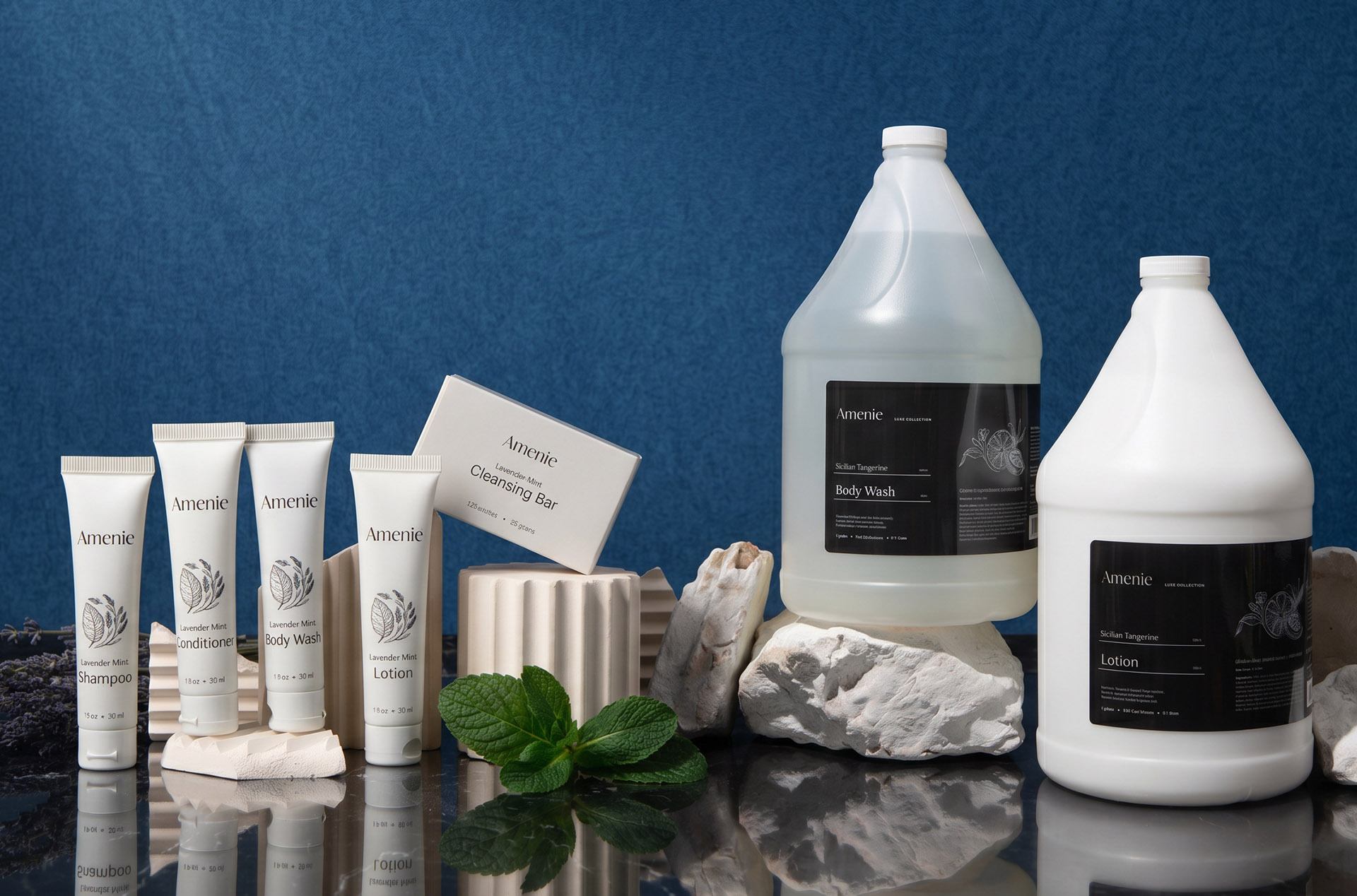
- Match amenities to your property type and guest expectations: from single-use travel-size formats to bulk gallon refills for dispenser systems
- Plan order quantities by room count: so your first order is calibrated to your occupancy and reorder cycle, not a round number guess
- Support consistent replenishment: with a product range that stays in stock and ships reliably, so your lead times stay predictable
Managing par levels across multiple properties? A standardized formula applied per property, combined with consolidated reorder cycles, keeps procurement predictable at scale. Our purchasing program for hotels is built for exactly that.
Whether you're setting up par levels for the first time or tightening an existing inventory system, starting with the right supplier and the right product format makes the math easier to maintain.
Need help estimating the right order volume for your property? Reach out to our team. We can help you work through the formula based on your room count, occupancy, and replenishment schedule, and recommend the right formats and quantities to get started.
Frequently Asked Questions
What is a hotel amenity par level?
A hotel amenity par level is the minimum quantity of a guest supply item a property should have on hand between deliveries. It's calculated based on room count, occupancy rate, daily usage per room, and the number of days between reorders. When inventory drops to the par level, it's time to reorder.
How do I calculate amenity par levels for my hotel?
Use this formula: Par level = (rooms × occupancy rate × units per room per day × days between deliveries) + safety stock. For a 100-room property at 75% occupancy with a 14-day reorder cycle and 20% safety stock, the shampoo par level is 1,260 units.
How much safety stock should a hotel carry for amenities?
A general rule: carry 10% safety stock for properties with stable occupancy and reliable delivery, 20% for moderate seasonality, and 30% or more for peak season, remote locations, or suppliers with inconsistent lead times.
Should par levels be the same for all amenity types?
No. High-use items like shampoo and body wash have a usage rate of approximately 1.0 per occupied room per day. Lotion runs closer to 0.4-0.5. Request-based items like dental kits may be as low as 0.2. Applying the same par level to every amenity type leads to shortages on high-use items and overstock on slow movers.
What is the difference between a par level and a reorder point?
A par level is the ideal stocked quantity your property maintains between deliveries. A reorder point is the inventory level that triggers a new order. The reorder point is lower than the par level and accounts for supplier lead time: Reorder point = (daily usage × supplier lead time) + safety stock.